| Brand Name: | Lingyao |
| Model Number: | LY-AF-25U |
| MOQ: | 1 set |
| Price: | USD 38,000–120,000/set |
| Delivery Time: | 30–45 days after deposit |
| Payment Terms: | T/T, L/C, Western Union |
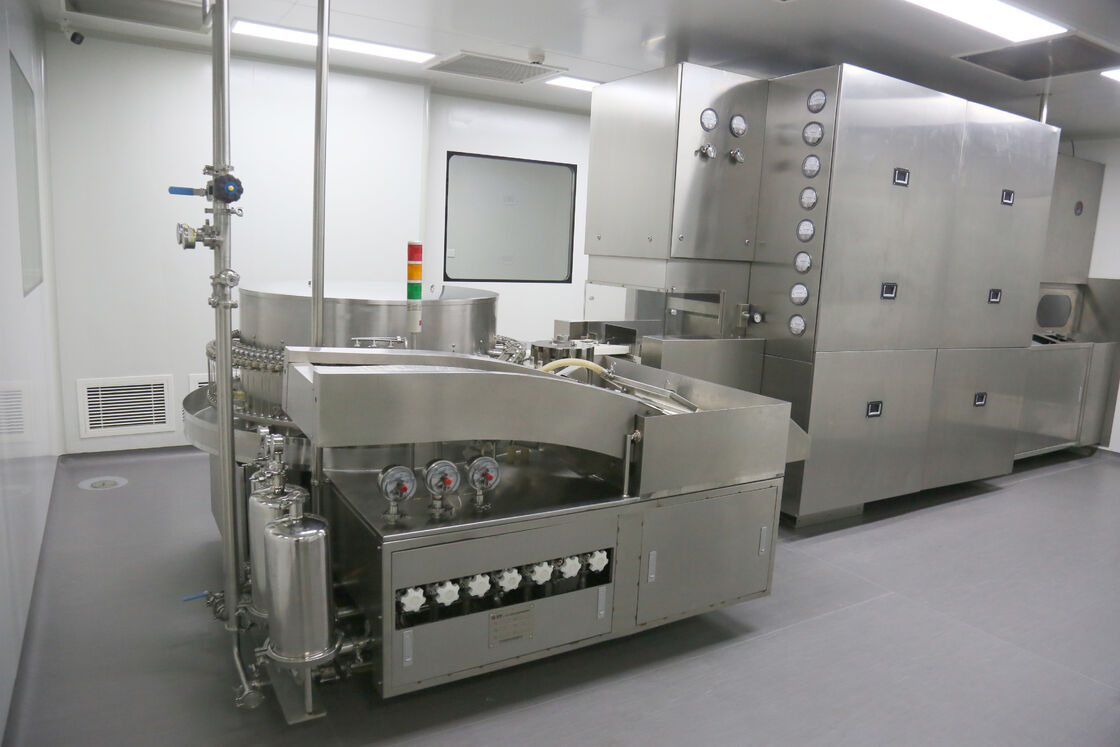
This ultrasonic washing ampoule filling machine combines ultrasonic cleaning, automatic transfer, liquid filling and flame sealing in one system. Ultrasonic washing is the decisive step for injectable glass because it removes sub-micron particles that jet washing alone cannot dislodge from the inner wall. The automatic transfer system moves ampoules between stations without human contact, preserving the cleaning result all the way to sealing.
ProblemParticle contamination is the leading cause of injectable product recalls worldwide. Standard water-jet washing removes gross debris but leaves fine particles and dried residues adhered to the glass wall by electrostatic forces. When those particles enter the drug solution, they can trigger visible foreign-matter failures in the 100% inspection step, and the rejected batch share can reach 3–5% on sensitive products.
CauseJet washing relies on water impact energy, which decreases sharply with particle size: the adhesion force of a 1µm particle is dominated by van der Waals forces that water jets cannot overcome. Residual detergent films and glass dust from the forming process also bond chemically to the wall. Without a cavitation mechanism, these contaminants remain until the ampoule is filled.
SolutionThis machine adds an ultrasonic washing stage where 28 kHz transducers generate cavitation bubbles that implode at the glass surface, releasing particles down to 0.5µm from the wall. A three-stage process—ultrasonic bath, high-pressure water jet rinse, and filtered compressed air drying—guarantees internal cleanliness verified by the light-obscuration particle test. The automatic transfer star wheels then carry ampoules directly to the filling station, so cleaned surfaces are never touched again.
Key Features| Parameter | Specification |
|---|---|
| Ultrasonic Frequency | 28 kHz, 600 W transducer array |
| Filling Range | 1–20 ml |
| Production Capacity | 6,000–10,000 pcs/h |
| Filling Accuracy | ±0.5% |
| Washing Stages | ultrasonic + jet rinse + air drying |
| Rinse Water | purified water / WFI (0.22µm filtered, optional) |
| Drying Air | filtered compressed air, 0.4 MPa |
| Sealing Method | automatic flame sealing |
| Air Pressure | 0.6–0.8 MPa |
| Power | 10.5 kW, 380V/50Hz |
| Dimensions | 4,200 * 2,000 * 1,800 mm |
| Machine Weight | 2,300 kg |
This machine is the right choice for products with strict particle limits, including antibiotics, cardiovascular injections, and contrast media where visible particle rejection is a major cost driver. It is also specified by plants that have failed foreign-matter audits and need a documented cleaning improvement. The ultrasonic stage is particularly valuable for lyophilized drug ampoules that undergo freeze-drying, where residual particles become highly visible after reconstitution.
Facilities processing recycled or third-party glass ampoules benefit most, since reused glass carries more surface contamination than fresh tubing glass.
Selection GuideConfirm your particle control requirement first: if your product passes easily with jet washing, the ultrasonic option may be unnecessary cost; if you see 1–3% foreign-matter rejection, ultrasonic washing typically pays back within one production year. Second, specify your rinse water quality, because WFI rinsing requires a higher water consumption of about 1.5 m³/h. Third, check ampoule supply: heavily soiled or aged glass may require a pre-wash step before the ultrasonic bath, which we can add as an option. Finally, request particle test data from the supplier's FAT to verify cleanliness performance with your ampoules.
FAQQ: How much better is ultrasonic washing than jet washing in practice?
In standard tests with intentionally contaminated ampoules, ultrasonic washing reduces residual particles above 10µm by over 90% compared with jet-only washing. Light-obscuration readings typically drop from several hundred to below 20 particles per ml.
Q: Does ultrasonic energy damage thin 1ml ampoules?
No. The transducers operate at 28 kHz with controlled power, and ampoules are held in cushioned pockets. We have run 1ml ampoules at full output for years without glass damage; the cavitation energy is directed at the liquid, not the glass structure.
Q: Can the ultrasonic stage be retrofitted to an existing ampoule line?
Yes, the washing module is available as a stand-alone unit with its own transfer interface. We supply retrofit kits for most common ampoule filling machines, including documentation for re-validation.
Q: What maintenance does the ultrasonic system require?
The transducer array should be inspected every 2,000 operating hours, and the bath water is changed per your water quality schedule. Normal consumables are limited to transducer seals and water filters.
Packaging & Quality AssuranceEvery machine is test-run with water and dummy ampoules for 72 hours before packing, and a sealed calibration report is shipped with the unit. The machine is wrapped in anti-rust film and secured in an export-grade wooden case with foam inserts, suitable for sea or air freight. We supply CE, GMP and ISO 9001 documentation, a 12-month warranty on parts, and lifetime remote technical support. On-site installation, operator training and IQ/OQ/PQ validation assistance are available on request.